The Prestige Trap
Why Barbados must Ignore ‘The Shiny’ and embrace ‘The Journey’

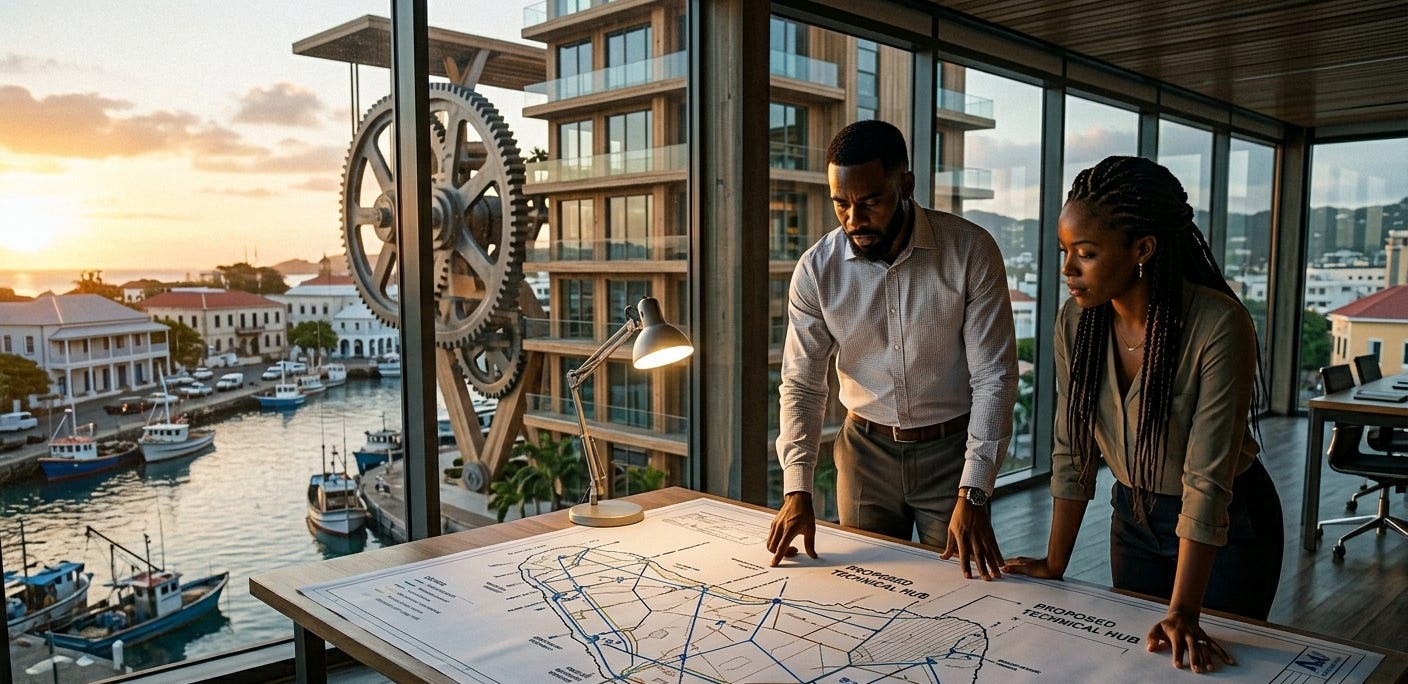
In my last article, I explored Dan Wang’s thesis in Breakneck: the divide between the Engineering State (which builds) and the Lawyerly Society (which buys and contracts). As I reflected on that article and engaged in conversation with my Bajans and others in the Caribbean who read the article, my mind kept going back to a particular paragraph, and I had to expand a bit more on it. When discussing the jet bridge conundrum, I explained that a country with an engineering mindset would ask, rather than buy the solution:
“How do we build a modular, Caribbean-hardened boarding system using local steel, local hydraulics, and local software?” Even if the first version isn’t as “shiny” as a European model, the knowledge stays in Barbados.”
So in my conversations I realised, we have become a society obsessed with the appearance of development while remaining terrified of the process of developing. We want the shiny, European-standard airport, the “First World” digital ID, and the seamless transport network—but we want them as “turnkey” products we can buy off the shelf.
For me, the issue here is that we don’t seem to want to embark on The Journey; we want instant gratification. But it is the journey that is valuable to us as a society. It’s the period of time between having a vision and creating a ‘shiny’ product when everything is broken and nothing works perfectly, but national intelligence grows by the hour. It is this intelligence that will be the pillar upon which our long-term sustainable development depends, not the ‘shiny’ product.
The Electric Bus: A Case Study in “Buying the Shiny”
Take our recent transition to electric buses. On the surface, it looks like progress: a quiet, emission-free fleet that mirrors the streets of London or Shenzhen. But in the “Lawyerly Society,” this was treated purely as procurement. We wrote a contract, paid the capital, and imported the finished product.
An Engineering Society would have looked at that multi-million dollar investment and asked: “How do we use this mandate to jumpstart a local assembly industry?” * Could we have imported the chassis and batteries but engineered the bodywork and cooling systems locally to handle our unique humidity and salt air?
Could we have tasked the SJPI, BCC or UWI and local software developers to build the fleet management and charging grid software?
By “Buying the Shiny,” we got the buses, but we missed the Process Knowledge. We didn’t create a generation of Bajan EV engineers; we created a generation of EV drivers and overseas-dependent mechanics. We chose the appearance of a “Green Economy” over the actual engineering of one.
The Cost of Skipping “The Journey”
We must stop treating development like a shopping trip and start treating it like a laboratory. When we skip the journey, we don’t just miss out on the technology; we allow our existing industrial pillars to waste away.
The ACME Vision: A Lost Opportunity
Consider ACME Manufacturing Company (if it still existed). For decades, ACME has been a quiet titan of Barbadian industry, possessing the specialized knowledge of how to build and repair large-scale vehicles for our unique environment. In a true “Engineering State,” the transition to electric buses would have been ACME’s finest hour.
Instead of a simple procurement contract with a foreign vendor, an engineering-led vision would have seen a partnership. Imagine if we had used the capital for the bus fleet to commission ACME to:
Design and Assemble: Import the core EV drivetrains and battery packs, but task ACME with designing and building the chassis and bodies to bespoke Caribbean specifications (such as enhanced rust-proofing for our salt air).
Establish a Regional Hub: By “learning by doing” with our own fleet, ACME could have become the primary maintenance and assembly hub for EV transport across the OECS.
Retain the Talent: Instead of our best mechanics and fabricators looking for work abroad, they would be the masters of a new, high-tech domestic industry.
By ignoring an ACME in favour of a “shiny” imported product, we didn’t just buy buses; we side-lined our own experts. We chose the convenience of a foreign warranty over the sovereignty of local capability. Could we have brought ACME back as part of a national plan? Just a thought.
The Prize if We Pivot
To show specific examples we can learn from, here are three global examples of what happens when a nation chooses The Journey over the ‘shiny now’.
1. Brazil’s Embraer: Mastering the Sky from the Ground Up
In the 1960s, Brazil could have continued to buy American or British planes to look like a modern nation. Instead, they decided they wanted to be an aerospace nation.
The Journey: They didn’t start with a supersonic jet. They started by license-building simple trainer planes. They accepted that for twenty years, they would be “learners.”
The Result: Today, Embraer is a global giant. They didn’t buy an airforce; they engineered an industry.
2. South Korea’s “Pony”: The Beauty of a Bad Car
In the 1970s, Hyundai had never built a car. Their first model, the “Pony,” was objectively mediocre—boxy, underpowered, and mocked by critics. In my research this example made me laugh as I remember the Pony car on the streets of Barbados in my younger days. They were quite ugly. I also remember the Hyundai Stellar, it was like the Starship Enterprise with wheels, it was massive.
The Journey: South Korea could have kept importing Fords to maintain the “appearance” of modern roads. Instead, they viewed the Pony as a moving laboratory. They knew that by building a bad car today, they would learn how to build a world-class car tomorrow.
The Result: South Korea now leads the world in EV innovation. They endured the “unshiny” phase to win the future.
3. Estonia’s X-Road: Engineering Sovereignty
After 1991, Estonia was a poor, post-Soviet nation. They had a choice: buy a digital government suite from a US tech giant or build their own.
The Journey: They chose to build X-Road, a local data exchange layer. It was buggy and risky. But they allowed local students and engineers to build the backbone of the state because they wanted to own the code.
The Result: Estonia is now the most digitally advanced society on earth. They didn’t buy “Digital Estonia”; they engineered it.
The Barbados Dilemma: The “Inferiority Complex”
Why is this journey so hard for us? In Barbados, we suffer from a high ‘Shame Index’ and thus a stifling Inferiority Complex (despite what we say).
If a homegrown technical solution—like a modular jet bridge designed by local engineers or a locally-assembled bus—has a glitch on day one, it isn’t treated as a “Beta test.” It is treated as a political scandal. The public ridicules it, and the opposition uses it as proof of incompetence.
This fear of public failure forces our leaders back into the “Lawyerly” safe space: Buying the foreign ‘thing’. When we buy a foreign solution, we are safe from ridicule because if it breaks, we can blame the vendor. But we are also robbed of the knowledge.
Conclusion: The Sovereignty of ‘The Journey’
If we are to solve our transport, housing, and water issues, we have to stop being “ambivalent” about the journey.
We need to create a “Safe Space for Failure”—a category in our laws for Experimental Public Infrastructure. We need to celebrate the “Pony” version of our local innovations. True development isn’t the shiny electric bus at the end of the road; it is the collective “Process Knowledge” of the Bajans who learned how to build and maintain it.
Until we are brave enough to be “unshiny,” we will never truly be developed.